
How on-demand FTP works
If FTP is essential, start your own FTP server from the web uploader whenever you need it. It's ready in about 30 seconds and switches itself off when you're done.
Your own FTP server, when you need one
People in Pro and Enterprise workspaces can start their own FTP server from the web uploader. Each person gets their own server, at a personal address that never changes, so you set up your FTP app once. Nothing runs when you're not using it: it switches itself off after an hour without activity.
1 November 2026Our always-on shared FTP servers close on 1 November 2026. Using them today? Start your own server and change the host in your FTP app.
How it works
Four steps the first time. After that, start your server and upload.
1. Open the web uploader
Go to
upload.photohawk.comand sign in, or open a gallery's Upload tab.2. Start your server
Click FTP server at the top, then Start FTP server. It's ready in about 30 seconds.
3. Copy the address and login into your FTP app
Your address, port 21, your Photohawk email and password. The address never changes.
4. Upload
Add your photos to the gallery's folder. It switches off after an hour with nothing uploaded.
Opens the web uploader with your FTP server ready to start.
What you'll see
Everything is in the Your FTP server panel in the web uploader, with a copy button next to each detail.
- Your address, like
swift-heron-4821.ftp.photohawk.com. It's yours for good, so you only set it up once. - The server's IP address is shown too. It changes each time you start the server, so use the address when you can.
- A countdown to when it switches off, with Keep it running and Stop.
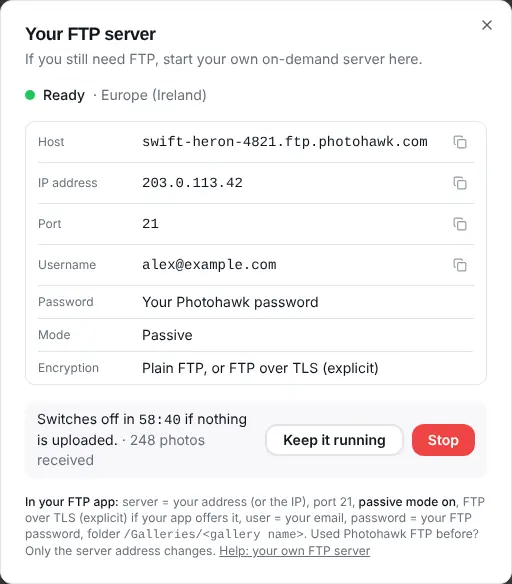
Your connection details
Enter these in your FTP app.
- Host
- Your address, e.g.
swift-heron-4821.ftp.photohawk.com(or the IP address shown) - Port
- 21
- Username
- Your Photohawk email
- Password
- Your Photohawk password, or your FTP password (below)
- Transfer mode
- Passive
- Encryption
- Plain FTP, or FTPS (explicit FTP over TLS). For FTPS, use the host name, not the IP address.
Already used Photohawk FTP? Keep your username, password and folders. Just change the host to your new address.
An FTP-only password, if you'd like one
Rather than saving your Photohawk password in an FTP app, click Create FTP password in the panel. It only works on your FTP server, with your email as the username. You can copy it, make a new one (the old one stops working within a minute) or remove it at any time. Your Photohawk password keeps working too.
Your folders
You'll see the same folders as before:
/Galleries/<gallery>/<collection>
- A gallery with one collection is simply
/Galleries/<gallery>. - Upload to more than one workspace? Each one has its own folder, with its galleries inside.
- Create the gallery and its collections in Photohawk first. Your photos appear in the gallery within moments, just as with the web uploader.
It switches itself off
Your server switches off after 1 hour without activity, so there's nothing to remember. The panel shows a countdown.
- Keep it running restarts the countdown without uploading anything.
- Stop switches it off straight away when you've finished.
- To be safe, it also switches off after 12 hours once nothing is uploading, and after 24 hours at most.
- Start it again whenever you like, with the same address and login.
Regions
Run your server in Europe (Ireland), US East (N. Virginia) or Asia-Pacific (Malaysia). The nearest one is picked for you, and you can change it before you start.
Example: setting up FileZilla
Other FTP apps use the same settings, sometimes under slightly different names.
- Open File → Site Manager and click New site.
- Protocol: FTP – File Transfer Protocol.
- Host: your address, e.g.
swift-heron-4821.ftp.photohawk.com. Port:21. - Encryption: Use explicit FTP over TLS if available.
- Logon Type: Normal. User: your Photohawk email. Password: your FTP password or Photohawk password.
- On the Transfer Settings tab, choose Passive. Click Connect, then open
Galleries.
Sending a big folder? FileZilla sends 2 at a time by default, and no more than 10. You can raise its simultaneous transfers setting up to 10 (Settings → Transfers), or use the web uploader, which sends many more at once.
If something doesn't work
Can't connect
Check the panel says Ready. If the host name was only just created, use the IP address for a minute.
Connected, but the folder list hangs
Turn on passive mode.
“Too many failed logins”
Wait 15 minutes, then check the username (your email) and password.
Questions
Why did my server switch off?
It switches off after an hour without activity, so it never runs when you're not using it. Start it again any time: the address and login stay the same. To keep it going without uploading, click Keep it running. It also switches off after 12 hours once nothing is uploading, and after 24 hours at most.
Can two people run servers at once?
Yes. Everyone in your workspace can start their own server, one each, at their own address. Only you can log in to yours.
Is it secure?
Yes. With FTPS (FTP over TLS) on your host name, the connection is encrypted with a trusted certificate. Only your login works on your server, and after repeated failed logins the server locks that connection out for 15 minutes.
Do I pay extra?
No. Your own FTP server is included in Pro and Enterprise.
What about Free workspaces?
Upload with the web uploader or Photohawk Studio, on every plan. Your own FTP server needs Pro.
What happens to the old shared FTP?
The always-on shared FTP servers close on 1 November 2026, and work as before until then. To keep using FTP, start your own server and change the host in your FTP app to your new address. Your username, password and folders stay the same.
Ready when you are
For everyday uploads, use the web uploader. When FTP is essential, your own server is a click away.